 Katrina Griffiths
Senior editor
Published on: October 26, 2026
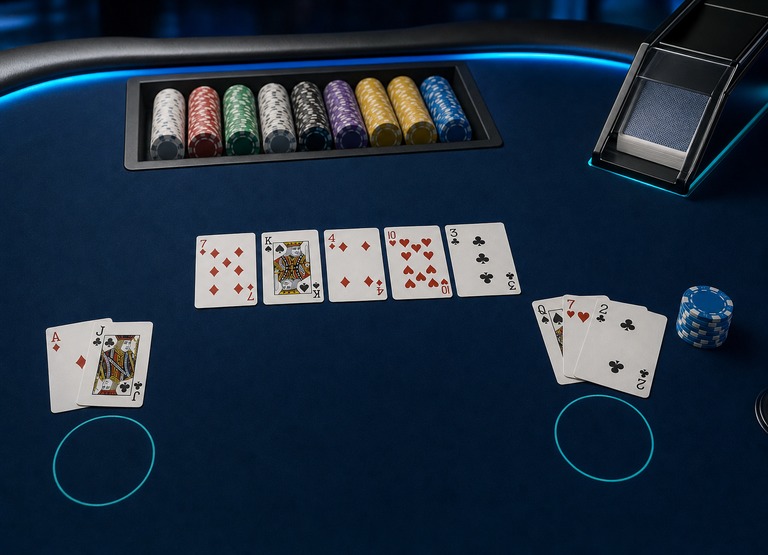
Casino Hold’em and Three Card Poker: how table poker works against the house
Casino Hold’em and Three Card Poker look like poker, but you’re not playing anyone at the table except the dealer. You put down an ante, look at your cards, and either fold or pay more to see the hand out. The dealer plays by fixed rules, so there’s nobody to outthink, and a short strategy handles nearly every decision you’ll face.
Play them properly and Casino Hold’em costs about 2.2% of your ante, Three Card Poker about 3.4%. The side bets cost more. With Pair Plus in Three Card Poker, the price swings a lot depending on which paytable the table uses, which is worth knowing before you sit down.
How table poker differs from regular poker
At a regular poker table, the casino takes a cut of each pot and the players fight over the rest. Table poker is house-banked. You win or lose against the dealer’s hand, and what you’re paid comes from a fixed paytable.
You get one real decision per hand: keep going or fold. The correct answer for every possible hand has already been worked out. If you follow it, you’re paying the lowest house edge the game allows. If you don’t, you pay more, and no amount of experience gets you past zero.
How a hand of Casino Hold’em works
If you know Texas Hold’em, the hand rankings are the same. You and the dealer each get two cards, and there are five community cards on the board.
- You place an ante and get two cards face up. The dealer gets two face down, and the first three community cards (the flop) go on the table.
- Now you decide. Fold and you lose the ante. Call and you add a second bet, twice the size of your ante.
- If you call, the last two community cards are dealt and the dealer turns their cards over. Each side makes its best five-card hand from its two cards plus the board.
For the dealer to qualify, they need a pair of fours or better. When they don’t, your ante gets paid from the paytable below and your call bet comes back to you. When they do qualify and you have the better hand, the ante pays from the paytable and the call pays even money. Lose and both bets go. A tie hands both back.
| Your hand | Ante pays |
|---|---|
| Royal flush | 100:1 |
| Straight flush | 20:1 |
| Four of a kind | 10:1 |
| Full house | 3:1 |
| Flush | 2:1 |
| Straight or lower | 1:1 |
That’s the standard paytable. Your table’s version is in the game information panel, and if any line pays less than this, the house edge goes up.
Casino Hold’em strategy
Because the call costs twice the ante, folding feels like the safe move. Most of the time it isn’t. Perfect strategy calls about 82% of hands and folds only around 18%.
You don’t need the full chart. This gets you very close:
- Call with any pair or better, even if the pair is only on the board.
- Call with four to a flush or an open-ended straight draw.
- Call with an ace or king in your hand if the flop isn’t paired.
- Fold low, unconnected cards that got nothing from the flop.
Calling with a mediocre hand makes more sense once you remember the dealer doesn’t always qualify, and when they don’t, your call bet simply comes back. Stick to the standard paytable and full strategy and the house edge sits at about 2.16% of the ante.
The AA Bonus side bet
Most Casino Hold’em tables have an AA Bonus spot. It pays if your two cards plus the flop make a pair of aces or better, no matter what the dealer holds, and a royal flush pays 100:1. The catch is the house edge, a little over 6%, or nearly three times what the main game costs. We’d leave it alone, or at least keep it much smaller than your ante.
How a hand of Three Card Poker works
Three Card Poker works on the same idea as Casino Hold’em, only stripped down. Three cards each, nothing on the board. You put chips on the ante, Pair Plus or both, check your hand, then fold or make a play bet the same size as your ante.
The bar for the dealer is lower here: queen-high qualifies, which happens roughly seven hands in ten. If the dealer misses, the ante pays even money and the play bet comes back. If they qualify, whoever has the better hand wins both bets at even money. Most tables also pay an ante bonus on strong hands, win or lose against the dealer: 1:1 for a straight, 4:1 for three of a kind and 5:1 for a straight flush.
Regular poker players tend to trip over one thing. With three cards, a straight is harder to make than a flush, so a straight ranks higher.
| Hand | Example | Chance of being dealt |
|---|---|---|
| Straight flush | 5-6-7 of hearts | 0.22% |
| Three of a kind | 9-9-9 | 0.24% |
| Straight | J-Q-K, mixed suits | 3.26% |
| Flush | 2-8-J of spades | 4.96% |
| Pair | 7-7-K | 16.94% |
| High card | Q-9-4 | 74.39% |
Three Card Poker strategy
This one is easy to remember: play with queen-6-4 or better, and fold anything lower.
Read your hand from the highest card down. Q-7-2 plays, since the 7 beats the 6. Q-6-3 folds, since the 3 falls short of the 4. A pair or anything better always plays. Stick to that and the ante and play bets together cost about 3.37% of the ante.
You’ll see players who never fold, and others who copy the dealer and play any queen-high. Both approaches cost more than Q-6-4, and over a long session the difference adds up.
Pair Plus and its two paytables
Pair Plus is a bet on your three cards alone. A pair or better pays, and the dealer’s hand doesn’t come into it. There’s no decision to make, so the paytable decides what it costs you.
| Hand | Common paytable | Weaker paytable |
|---|---|---|
| Straight flush | 40:1 | 40:1 |
| Three of a kind | 30:1 | 30:1 |
| Straight | 6:1 | 6:1 |
| Flush | 4:1 | 3:1 |
| Pair | 1:1 | 1:1 |
| House edge | 2.32% | 7.28% |
The only difference is the flush payout, 4:1 against 3:1, and it roughly triples what the bet costs. You can’t tell the two apart from the lobby, so open the paytable first. If it’s the 3:1 version, skip Pair Plus. Some tables also offer a Six Card Bonus, which uses your cards and the dealer’s together, and again its edge depends on the paytable in the game panel.
What each game costs you in dollars
Multiply the house edge by your stake and you get the average cost. With a $10 ante and correct play, that’s about 22 cents a hand in Casino Hold’em and about 34 cents in Three Card Poker. A $10 Pair Plus bet works out to 23 cents on the common paytable and 73 cents on the weaker one.
These are averages over a lot of hands. A short session can go well or badly, but the longer you play, the closer you drift toward those numbers. Speed makes a difference too. RNG tables deal as fast as you click, so the same bet ends up costing more per hour than it would at a live table. There’s more on this in our piece on online casino myths and the math behind them.
Playing table poker online in Alberta
You’ll usually find both games two ways: RNG versions where software deals, and live dealer tables streamed from a studio. Everything in this guide applies to both, as long as the table uses the standard paytables above.
On AGLC-registered sites, games are independently tested and certified, and the paytable and expected return should be in each game’s help panel. Table poker usually sits with the other casino games in the lobby. Three Card Poker hands are over in seconds, so pick a deposit or session limit before you start rather than halfway through.
Casino Hold’em and Three Card Poker FAQ
Which is better value, Casino Hold’em or Three Card Poker?
On the main game, Casino Hold’em, at about 2.16% of the ante compared with 3.37%. Three Card Poker is simpler and quicker, though, and its Pair Plus bet on the common paytable costs less than the AA Bonus in Casino Hold’em.
How do they compare with blackjack and baccarat?
Both cost more than blackjack with basic strategy or the banker bet in baccarat. They’re closer to European roulette, which sits at 2.70%.
Can you count cards in these games?
Not in any way that helps. RNG games reshuffle every hand, and live tables reshuffle often enough that tracking cards won’t give you a practical edge.
Conclusion
For Casino Hold’em, call with most hands and only fold the ones the flop did nothing for. For Three Card Poker, remember Q-6-4, and look at the Pair Plus paytable before putting money on it. The side bets cost noticeably more than the main games, so if you play them, keep them small. And set your budget before the first hand, not after a bad run.
You must be 18 or older to gamble online in Alberta. If gambling is causing problems for you or someone you know, the Alberta Health Services Addiction Helpline is open 24/7 on 1-866-332-2322, and GameSense, AGLC’s responsible gambling program, has free tools and advisors.