 Katrina Griffiths
Senior editor
Katrina Griffiths
Senior editor
Published on: September 1, 2026
Baccarat explained: rules, bets, and why it’s popular online
Baccarat is a game with three bets and no decisions. You back the player hand, the banker hand, or a tie. The cards are dealt according to fixed rules, and whichever hand finishes closest to nine wins.
Two of those bets are among the cheapest at the casino, and the third is one of the most expensive on the floor.
Where the game came from
The origins of Baccarat are disputed, but one account has the game arriving in France from Italy at the end of the 15th century, carried back by soldiers returning from the Italian Wars.
Baccarat banque is the oldest surviving form, and it grew up in private clubs because France didn’t legalize casino gambling until 1907. Chemin de fer followed later in the 19th century, with players taking turns holding the bank and passing the shoe around the table.
The version you’ll meet online is younger and simpler. Punto banco became a house-banked game in Havana in the 1940s and reached Las Vegas at the end of the 1950s, taking decisions entirely away from players. Ian Fleming’s Casino Royale, published in 1953, still has Bond at a chemin de fer table.
How a hand works
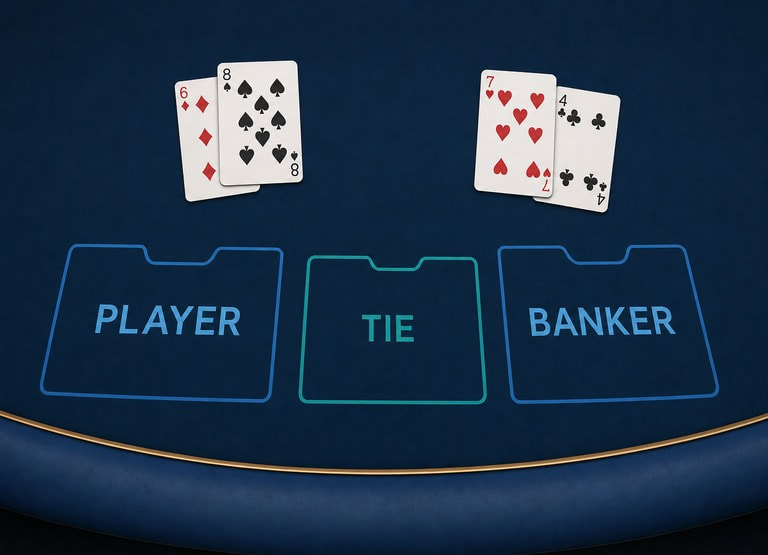
Two hands come out of an eight-deck shoe, one called Player and one called Banker. Neither is yours. You’re betting on which finishes closer to nine, or on the two finishing level.
Card values:
- Aces count 1.
- Cards 2 through 9 count their face value.
- Tens, jacks, queens and kings count 0.
Totals drop the tens digit, so a 7 and an 8 make 15, which plays as 5. Nine is the highest total a hand can hold, and no hand can bust. An 8 or a 9 on the first two cards is a natural: the hand ends there and the higher total wins.
The third-card rules
When neither hand is a natural winner, a fixed table decides whether a third card is dealt. Neither you nor the dealer gets to choose.
- The player hand draws on 0 to 5 and stands on 6 or 7.
- If the player hand stood, the banker hand follows the same rule.
- If the player hand drew, the banker’s move depends on its own total and on the card the player drew.
The rest of the table applies automatically, and that’s why baccarat has no strategy to learn. Compare it with blackjack, where your own decisions move the return by more than a percentage point.
The three bets and what they cost
The figures below are for the standard eight-deck game.
| Bet | Pays | Wins | House edge |
|---|---|---|---|
| Banker | 1 to 1, less 5% commission | 45.86% | 1.06% |
| Player | 1 to 1 | 44.62% | 1.24% |
| Tie | 8 to 1 | 9.52% | 14.36% |
A tie isn’t a loss on the main bets: level hands return player and banker stakes.
Banker and player are close enough that the choice barely matters. The tie is the outlier: it pays 8 to 1 for a result that turns up roughly once in every ten and a half hands, and it costs more than thirteen times what the banker bet costs.
Why the banker bet pays commission
The banker hand acts last, after it has seen whether the player drew and what card came out. The 5% commission on winning banker bets is what claws it back.
Some tables drop the commission and pay a winning banker six at half your stake instead. That lifts the banker edge from 1.06% to about 1.46%, worse than the player bet. The two versions look near identical in the lobby, so read the game title before you sit down.
Side bets
Side bets are priced closer to a lottery ticket than a table bet:
- Player pair and banker pair pay 11 to 1 when that hand’s first two cards match.
- Either pair and perfect pair variations sit in the same range or higher.
- Dragon and bonus bets pay on the margin of victory, and their cost depends on the paytable in the game panel.
A pair bet costs roughly ten times what a banker bet does, so never size one like a main bet.
Variants you’ll meet online
Punto banco is the version described above, and nearly every table in an Alberta lobby runs it. The variants change the pace or the paytable rather than the hand:
- Speed baccarat deals the same game on a shorter clock.
- No-commission tables swap the 5% for the half-payout on a banker six.
- Multiplier tables such as Lightning Baccarat add a 20% fee to every bet to fund random card multipliers, at much higher variance.
Chemin de fer, the version Fleming’s Bond played, has all but disappeared online, because it needs players willing to bank against each other. RNG versions run the same math without a dealer, usually at a lower minimum. Whichever you open, the return sits in the game information panel, and how easily you can find it is a fair proxy for the operator. Baccarat tables sit with the rest of the casino games.
Why it’s popular online
Baccarat travelled better than any other table game. About 91% of Macau’s casino income in 2014 came from punto banco, and the online lobbies were built for that audience first. Three things carried it:
- There’s nothing to learn. A first-time player and a veteran get the same 1.06% on banker.
- Online minimums are a fraction of the high-limit rooms it’s associated with in land casinos.
- Rounds are short, so a session feels active without asking anything of you.
That last one is where a cheap bet gets expensive. A standard live round runs 48 seconds, and since the edge doesn’t move, the same $10 bet costs you nearly twice as much an hour at the faster table. Set a deposit limit before the first hand, not after.
Roadmaps, and what they don’t tell you
Every live table displays roadmaps that record how earlier hands in the shoe finished, and players will read them for streaks. This habit predates the screens, since players once tracked shoes on paper scorecards the casino handed out.
However, these roadmaps should be treated carefully because they’re a record, not a forecast. Card removal from an eight-deck shoe shifts the odds by amounts far too small to bet on, and no pattern on the grid changes the 1.06%.
Conclusion
If you’re thinking about playing baccarat, consider betting on the banker, and perhaps skip the tie and pairs for now. It’s also a good idea to check whether the table charges a 5% commission or offers half the payout on a banker six. Keep an eye on the clock, because the number of hands played per hour really influences what this 1.06% house edge actually means for you.
Return and house edge across other games are covered on our slots and blackjack pages, and if you’re new to online casinos in the province, the new players guide covers registration and verification.
You must be 18 or older to gamble online in Alberta. If gambling is causing problems for you or someone you know, the Alberta Health Services Addiction Helpline offers free, confidential support 24 hours a day at 1-866-332-2322, and GameSense is AGLC’s responsible gambling program.