 Katrina Griffiths
Senior editor
Katrina Griffiths
Senior editor
Published on: 20.07.2026
Sports Betting Odds Explained: Moneyline, Point Spreads, and Totals
Alberta’s newly opened, AGLC-regulated sports betting market gives residents a legal way to bet with private operators for the first time. If you are new to sports betting, odds can look like a foreign language: strings of plus and minus numbers next to team names. This guide breaks down the three bet types you will see on every sportsbook: the moneyline, the point spread, and the total (over/under). By the end of this blog post, you will be able to read a betting board and know exactly what each number means before you place a bet.
How sports betting odds work
Odds do two jobs at once. They show the implied probability of an outcome, and they show the payout on a winning bet.
Alberta sportsbooks, licensed by the AGLC, use the American odds format: a plus or minus sign in front of a number.
A minus number marks the favourite and shows how much you must stake to win $100. A plus number marks the underdog and shows how much a $100 stake wins. The number scales to any stake, so you do not need to bet in hundreds. Reading the sign first tells you which side the sportsbook expects to win before you calculate a single payout.
- -150 means bet $150 to win $100 (plus your original stake back)
- +130 means a $100 bet wins $130 (plus your original stake back)
- The vig (or juice) is the sportsbook’s built-in fee, which is why the odds on both sides of a bet rarely balance to an even 100% probability
What are Moneyline bets?
A moneyline bet is the simplest wager in sports betting: you pick the team you think will win the game outright. The margin of victory does not matter, only the result. This makes it a good starting point for new players because it requires no math beyond reading the plus or minus number next to each team.
Moneyline example
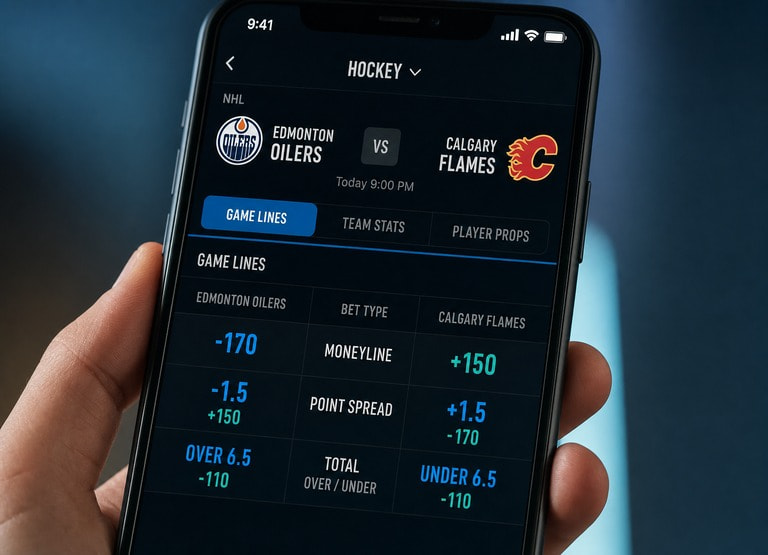
Take a hypothetical Battle of Alberta matchup:
- Edmonton Oilers -170 (favourite)
- Calgary Flames +150 (underdog)
A $50 bet on the Oilers at -170 wins about $29.41 if they win, plus your $50 stake back. A $50 bet on the Flames at +150 wins $75 if they pull off the upset, again plus your stake. It is the same game, with the same $50 at stake, but the payouts are very different. The sportsbook pays more for backing the Flames because, for this matchup, it rates their chance of winning as lower. That gap between the two payouts is the odds doing their job.
What is a Point spread bet
A point spread evens out two unequal teams by setting a margin of victory. The favourite must win by more than the spread to “cover” it. The underdog covers by losing by less than the spread, or by winning the game outright. Both sides are usually priced near -110, so once the spread is applied, the bet is close to a coin flip. That even pricing is the main difference from a moneyline, where one side pays far more than the other.
Point spread example
Using the same matchup, the spread might look like this:
- Oilers -6.5 (-110)
- Flames +6.5 (-110)
A bet on the Oilers at -6.5 wins only if they win by 7 goals or more. A bet on the Flames at +6.5 wins if they take the game outright or lose by 6 goals or fewer. The half-goal on the line removes any chance of a tie, so one side of the bet always wins.
What is a totals bets?
A totals bet, also called an over/under, is a wager on the combined score of both teams. You bet on whether that total finishes above or below a line set by the sportsbook, and it does not matter which team wins. Totals work well as a second bet type once moneylines feel comfortable, because they remove team-strength analysis: you only judge how high-scoring the game will be.
Totals example
For the same game, the total might be set at:
- Total: 6.5 goals (-110 either side)
Bet the Over and you need 7 or more combined goals for the bet to win. Bet the Under and you need 6 or fewer combined goals. The half-goal line means the game can never land exactly on the number, so one side always wins.
Which bet should new players start with?
A sensible order helps you build confidence before taking on the bets that need the most judgment.
Start with moneyline bets on a sport or league you already follow. That way, there’s no spread math; you just pick the winner. Move to totals once that feels comfortable, since it only requires judging combined scoring, not relative team strength. Try point spreads last because they need the most game-specific analysis and are the easiest to get wrong as a beginner.
Key sports betting terms to know
Refresher: These are the terms you will see most often on a sportsbook:
| Term | Description |
|---|---|
| Favourite | The team expected to win, shown by a minus (-) odds number |
| Underdog | The team expected to lose, shown by a plus (+) odds number |
| Push | A tie against the number (spread or total) & your stake is returned |
| Cover | A team beats the point spread, whether they win or lose the game |
| Vig/Juice | The sportsbook’s built-in fee on every bet |
| Implied probability | The chance of an outcome suggested by its odds |
Tips before you place your first bet
Building a few habits can protect your money and keep betting enjoyable from the first wager:
- Only bet with AGLC-licensed operators — check the operator list before you sign up
- Set a budget before you start and treat it as a hard limit
- Start with small stakes while you get used to how odds move
- Avoid parlays and combo bets until you understand single-bet odds first
Responsible Gambling
Sports betting should stay fun. It’s not a way to chase money you cannot afford to lose. Every AGLC-licensed operator offers player protections, such as responsible gambling tools like deposit limits and self-exclusion, for you to use. Free, confidential support is available anytime through GameSense. Set your limits before placing your first bet, and if betting ever stops feeling like entertainment, take a break and reach out for help.