 Katrina Griffiths
Senior editor
Katrina Griffiths
Senior editor
Published on: 14.07.2026
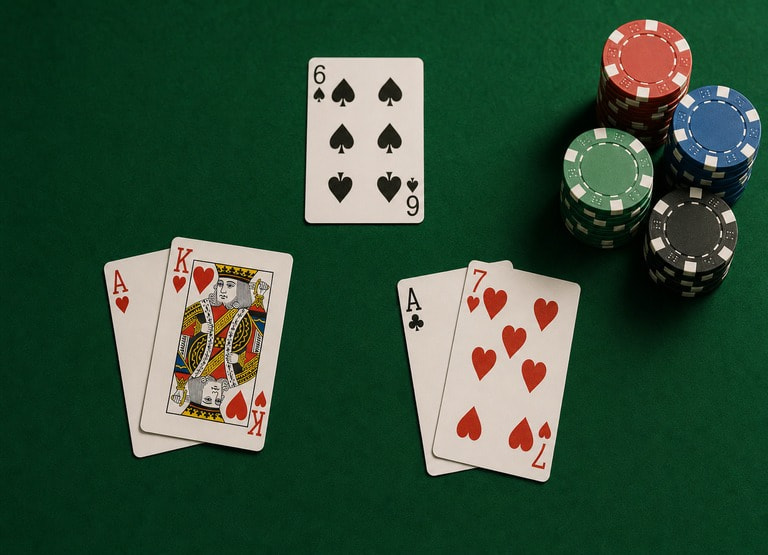
Blackjack basics: Rules, strategy, and house edge
Blackjack is the only table game in the casino where your decisions meaningfully change the outcome. It’s not slots or roulette where you place a bet and watch, instead every hand presents choices that directly influence how much the house takes from you over time. That combination of simplicity and genuine skill is why blackjack consistently ranks as the most played table game in North America.
This guide covers everything a newcomer needs to start playing: the rules of the game, how to read a basic strategy chart, and exactly why the house still holds an edge even when you play perfectly.
How to play blackjack
The objective of blackjack is straightforward: build a hand with a total closer to 21 than the dealer’s, without exceeding 21. You are not competing against other players at the table; it’s only you versus the dealer.
Card values
- Number cards (2–10): worth their face value
- Face cards (Jack, Queen, King): each worth 10
- Ace: worth 1 or 11, whichever benefits the hand more
The deal
Each round begins with players placing their bets. The dealer then distributes two cards to every player face-up and deals two to themselves: one face-up (the “upcard”) and one face-down (the “hole card”). Players act on their hands before the dealer ever reveals the hole card, which is what creates the central decision problem: you can see your own hand in full, but only half of the dealer’s.
Player options
- Hit: Request an additional card. You can hit as many times as you like until you choose to stand or until your hand exceeds 21.
- Stand: Keep your current hand and end your turn. No more cards are drawn.
- Double Down: Double your original bet and receive exactly one more card, then stand automatically. Best used when your hand total and the dealer’s upcard put the odds strongly in your favour.
- Split: If your first two cards are a pair, you can split them into two separate hands, each backed by a new bet equal to the original. You then play each hand independently.
- Surrender: Available at some tables. You forfeit half your bet and end the hand immediately. Strategically correct in a small number of situations where your hand is very likely to lose regardless of what you draw.
Dealer rules
The dealer has no decision-making authority because in most games they follow a strict, fixed set of rules. Traditionally, the dealer must hit on any total of 16 or lower and must stand on any total of 17 or higher.
One important variation is the soft 17 rule: some casinos require the dealer to hit on a soft 17 (an Ace + 6), rather than stand. This appears minor but adds approximately 0.22% to the house edge, so always check which rule applies before you sit down.
Key blackjack terms to know
- Hard hand — A hand that contains no Ace, or one where the Ace must count as 1 to avoid busting. Example: 9 + 7 = hard 16 OR 9 + 2 + 3 + 6 + Ace = 21
- Soft hand — A hand containing an Ace counted as 11 without busting. Example: Ace + 6 = soft 17. Soft hands are more flexible because the Ace can shift value.
- Bust — When a hand’s total exceeds 21. If the player busts, they lose immediately regardless of what the dealer holds. If the dealer busts, all remaining players win.
- Push — A tie. When the player and dealer finish with the same total, the original bet is returned with no win or loss.
- Natural / Blackjack — An Ace plus any 10-value card dealt as the initial two-card hand. Pays 3:2 at reputable tables.
- Shoe — The plastic device that holds and dispenses multiple decks of cards. Most casino blackjack games use a 6- or 8-deck shoe.
Blackjack basic strategy
Basic strategy is a mathematically optimal set of decisions for every possible combination of your hand total and the dealer’s upcard. It was first developed in the 1950s by a team of US Army mathematicians known as the Four Horsemen: Roger Baldwin, Wilbert Cantey, Herbert Maisel, and James McDermott. It was later refined through extensive computer simulation. The result is a complete decision chart that tells you exactly what to do in every situation: hit, stand, double, split, or surrender.
Basic strategy does not guarantee you will win every hand. What it does is minimize the house’s long-run advantage to the lowest mathematically possible level for the rules at your table.
How long does it take to learn basic strategy?
You can cover the most important decisions (hard totals, pair splitting rules, always split Aces and 8s, never split 10s) in an hour or two of focused study. Full memorization of the complete chart typically takes one to two weeks of regular practice. Most land-based casinos permit players to use a printed strategy card at the table, so there is no reason to wait until you have everything memorized before playing.
Hard hands strategy
Hard hands are where many blackjack decisions occur. The most important rules to remember:
- Always stand on hard 17 or higher. The probability of busting with one more card outweighs any potential gain.
- Always hit on hard 8 or lower. You cannot bust with a single card, so you should always take it.
- Double down on hard 11 against any dealer upcard except an Ace.
- Double down on hard 10 when the dealer shows a 2 through 9.
- On hard 12–16 (the danger zone): stand when the dealer shows 2–6, as they are likely to bust themselves. Hit when the dealer shows 7 or higher, as they are likely to make a strong hand.
Pairs strategy
When your first two cards form a pair, you have the option to split them into two independent hands. These rules are among the most important to memorize:
| Always… | Never… |
|---|---|
| Split Aces: two hands starting with an Ace is strong | Split 10s: a hand of 20 is one of the strongest |
| Split 8s: 16 is a weak hand, split it for two fresh hands | Split 5s: consider doubling down on 10 instead |
What is the best strategy for blackjack?
Basic strategy is the mathematically optimal approach for any recreational player. It reduces the house edge and requires no special talent. Card counting (tracking the ratio of high to low cards remaining in the shoe) can theoretically shift the edge to the player’s favour, but it requires extensive practice, a substantial bankroll to weather variance, and is actively discouraged or grounds for removal by casinos.
Common beginner mistakes
- Taking insurance: Insurance is a side bet that the dealer holds a natural blackjack. It pays 2:1, but the odds are against the player in virtually every circumstance.
- Standing on soft 17: The Ace can safely absorb a card without risking a bust, so hitting (or doubling against a weak dealer upcard) is almost always correct.
- Mimicking the dealer’s strategy: Dealers hit on 16 and under, stand on 17 and above. This sounds reasonable until you realize dealers never double or split, so forgoing those options costs players significantly over time.
- Playing at 6:5 tables: Sit only at tables paying 3:2 on blackjack.
The house edge in blackjack
The house edge is the mathematical advantage the casino holds over the player, expressed as the percentage of each bet the casino expects to keep over the long run. It is not a fixed fee and emerges from the structure of the game itself.
In blackjack, the casino’s core advantage comes from one rule: if the player busts, the player loses immediately, even if the dealer would have also busted on the same round. The dealer always acts last, and the player bears the bust risk first.
House edge with basic strategy
A player using perfect basic strategy reduces the house edge to approximately 0.5% under standard rules. To put that in perspective:
- American roulette: ~5.26% house edge
- Slot machines: 2–10% (varies widely by machine and jurisdiction)
- Baccarat (banker bet): ~1.06%
- Blackjack with basic strategy: ~0.5%
At 0.5%, a player betting $25 per hand over 100 hands (a typical hour of play) can expect to lose around $12.50 on average. That is the cost of entertainment, and it’s substantially lower than most other games in the building.
Common blackjack variants
Not every blackjack game follows identical rules. The core gameplay is consistent, but specific rule differences can significantly alter the house edge and the correct strategy. Before sitting down either online or in person, it is worth identifying which variant you are playing.
European Blackjack
The dealer does not receive their hole card until all players have completed their hands. This “no hole card” rule means players can lose the full value of doubled or split bets if the dealer later reveals a natural blackjack — a meaningful disadvantage not present in most North American games.
Vegas Strip Blackjack
Typically played with four decks. Late surrender is usually permitted, and the dealer peeks for blackjack before players act, protecting doubled and split bets. Generally, one of the more player-friendly variants available.
Pontoon
A British variant with different terminology: a “twist” replaces the hit, a “stick” replaces the stand. A Pontoon (Ace + 10-value card) and a five-card trick (any five cards without busting) are the two best hands. Rules differ enough that standard basic strategy does not transfer directly.
Live Dealer Blackjack
Available at regulated online blackjack casinos in Alberta, live dealer blackjack streams a real human dealer in real time via video feed. The game follows standard rules and closely replicates the feel of playing in a physical casino. Side bet options are common but should generally be avoided.
Tips before you play your first hand
- Learn basic strategy before playing for real money. Start with the key rules like always split Aces and 8s, never split 10s, stand on hard 17+. Even partial knowledge of the chart meaningfully cuts the house edge.
- Play only at 3:2 tables. If the table pays 6:5 on blackjack, walk away. This is the single most important table selection criterion, and one that most casual players overlook entirely.
- Set a session bankroll before you sit down. Decide in advance the maximum you are willing to lose and treat that figure as a hard limit. Never chase losses by increasing your bets after a bad run.
- Practice with free online games first. Many online casinos offer no-deposit play modes. Use them until basic strategy decisions feel instinctive before putting real money on the table.
- Avoid side bets. Perfect Pairs, 21+3, and similar side bets typically carry house edges of 3–10%. They are designed to look exciting; they are not part of a sound approach to the game.