 Katrina Griffiths
Senior editor
Katrina Griffiths
Senior editor
Published on: August 18, 2026

Coolbet Left Alberta the Day Before Launch. Here’s What an Operator Exit Actually Signals for Players
On July 12, 2026, Coolbet stopped serving Alberta. The next day, Alberta’s regulated online gambling market opened with 22 operators live. One brand had looked at the same starting line as everyone else and decided, the day before, to leave.
That timing is what makes the exit worth reading closely. Operators leave markets all the time, but usually the market is shrinking or under legal threat. Coolbet did the reverse. It left a market on the morning that market became legal, regulated, and open to private competition for the first time. If you are deciding where to open an account in Alberta this month, that decision is worth understanding, because it says something about which operators are built to stay.
What actually happened
Two dates matter here, and they are easy to blur. The exit was first reported in trade press around July 6 to 7, 2026, roughly a week before Coolbet actually went dark. The shutdown itself was staged rather than sudden.
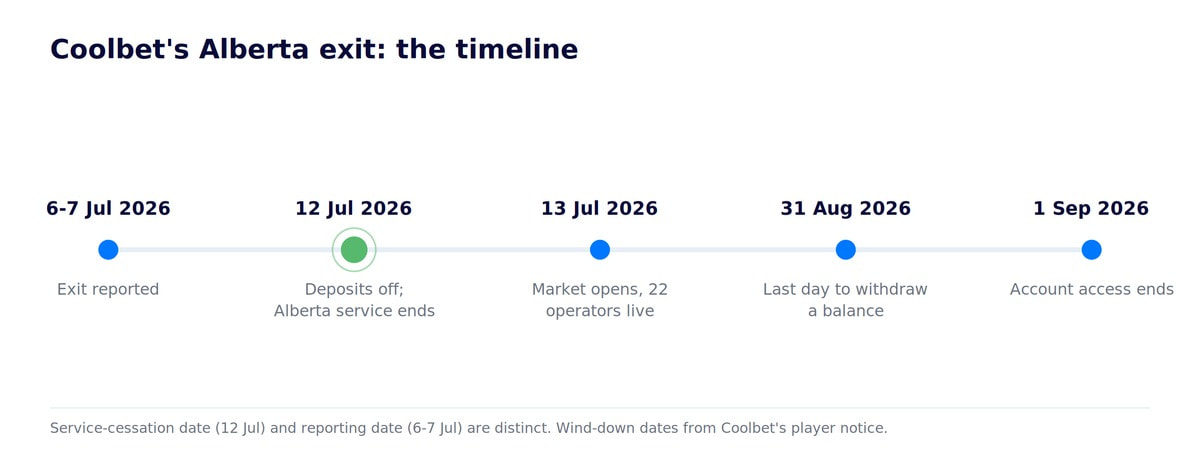
Coolbet’s own player notice put the move down to changes in regulations in the Alberta iGaming launch: “due to changes in Alberta’s iGaming regulations, we’ll no longer be able to offer our services in the province without a local licence. As a result, Coolbet will stop operating in Alberta from July 13, 2026.”
That wording matters. No regulator forced Coolbet out, and nothing collapsed mid-operation. This reads as a business decision not to complete registration under Alberta’s new framework, a company looking at what the regulated market would cost and deciding the numbers did not add up.
This is not Coolbet’s first exit
Coolbet has done this before. It launched in Ontario after that market opened in April 2022, then announced its withdrawal on March 16, 2023, cut deposits on March 21, and shut down fully around April 3, 2023, roughly a year in. The reason it gave at that time was more specific: heavy promotional competition from entrenched operators, and no clear path to profitability.
Two exits from two regulated Canadian markets, a little over three years apart, start to look less like bad luck and more like a pattern. Coolbet is a mid-sized international brand up against operators with far larger marketing budgets. In Ontario it could not outspend the field. In Alberta it seems to have decided not to try.
There is one more layer worth naming, though we flag it as our reading rather than a stated reason. Coolbet’s parent, GAN Ltd., was bought by Sega Sammy Holdings in May 2025. Ownership changes like that often bring a harder look at which markets earn their keep. No source connects the Sega Sammy deal to the Alberta decision, so we treat it as context, not cause. But a market a new owner sees as marginal is exactly the kind a new owner tends to cut.
Why an operator walks away from a legal market
Entering Alberta’s regulated market is not cheap, and the ongoing economics are demanding. Registration runs through two doors. An operator registers with the AGLC, then signs a commercial agreement with the Alberta iGaming Corporation (AiGC). Trade-press and legal-advisory summaries of the framework put the cost at a C$50,000 one-time application fee plus a C$150,000 annual registration fee per brand, with operators keeping 80% of gaming revenue and 20% going to the province after a 3% set-aside from gross gaming revenue (2% to First Nations, 1% to social responsibility).
For a market leader, those are rounding errors. For a mid-sized brand with modest Alberta share, a six-figure annual fee per brand, plus a 20% revenue share, plus the marketing spend needed to compete against bet365, BetMGM, DraftKings and the rest, can turn a market into a loss before a single hand is dealt.
Coolbet is not the only brand to weigh Alberta’s economics and hesitate, but it is the most visible case, because it entered and then left. A regulated market is a filter. The one-time and annual fees, the revenue share, and the marketing spend needed to compete all set a bar, and a brand has to believe it can clear that bar before it commits. Coolbet ran those numbers again and decided it could not.
What an exit actually means for your money
This is the part that matters most if you had, or were about to open, a Coolbet account, and it is the part most launch coverage skipped. An operator exit is not the same as an operator vanishing. In Coolbet’s case, there is a clear, staged wind-down. Deposits stopped on July 12, but withdrawals stayed open until August 31, and account access until September 1. A player with a balance has a defined window to get their money out.
The lesson generalizes. When an operator leaves a regulated market in an orderly way, three things are usually true, and each one is worth checking rather than assuming:
- There is a withdrawal window, and it has a deadline. Balances are not forfeited, but they are not accessible forever either. Find the date and act well before it.
- Deposits and promotions stop first. The moment you see an operator pull promotions or disable deposits in your province, treat it as a signal to withdraw, not a glitch.
- Verification still applies on the way out. A withdrawal during a wind-down goes through the same identity checks as any other. If your account is not verified, sort that out first, not last.
How to read an operator’s staying power before you deposit
Because we track licence and registration status across Alberta’s operators as part of deciding which safe online casinos in Alberta to list, an exit like this is less a surprise than a data point. You can run a rough version of the same check before you deposit anywhere:
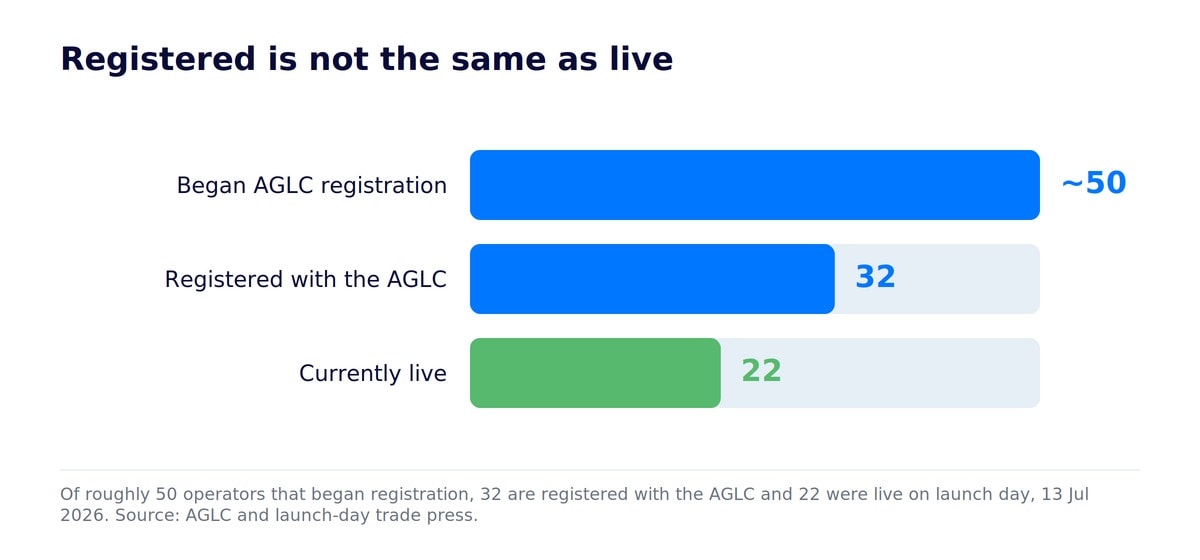
- Is the brand registered with the AGLC and live, or only announced? Of about 50 operators that began registration, 32 have registered with the AGLC and 22 are currently live. Registered is not the same as open, and announced is not the same as registered.
- Does the operator have real scale in the market, or is it a small entrant likely to struggle on marketing spend? The brands most likely to leave are the ones least able to compete for players.
- Has the brand left a Canadian market before? Past exits are public. A brand that left Ontario has already shown it will leave when the math turns against it.
None of this makes a smaller operator a bad choice today. It means that if you play at one, keep your balance lean and withdraw regularly, rather than treating the account as a place to park money.
Conclusion
Coolbet leaving Alberta the day before launch is not a scandal, and it is not a sign the market is unsafe. It is a straightforward business decision, made unusually visible by its timing, and a useful reminder that a licence tells you an operator met the standard to enter, not that it means to stay. The operators worth your deposit are the ones with the scale and the commitment to still be here next year. An exit like this is the market showing you, early and for free, which brands were never going to be among them. The ones that stayed are lined up in our comparison of online casinos in Alberta.
18+. T&Cs apply. Please play responsibly. For support visit GameSenseAB.ca or call the AHS Addiction Helpline: 1-866-332-2322.