 Katrina Griffiths
Senior editor
Katrina Griffiths
Senior editor
Published on: 29.05.2026
How Alberta’s Online Gambling Rules Compare to Other Provinces
If you’ve spent any time researching online casinos as an Alberta player, you’ve probably noticed that the rules aren’t the same everywhere in Canada. This is because each province controls its own gambling market, so the protections available to you, the operators you can legally use, and the standards those operators must meet all depend on where you live.
Let’s look at how Alberta’s framework stacks up against three provinces with the most developed online gambling regulation in the country: British Columbia, Ontario, and Québec.
How Canada Divides Gambling Authority
Canada doesn’t have a national gambling regulator. Under Section 207 of the Criminal Code the federal government allows provinces to conduct and manage gambling only within their own borders, then largely steps back. Each province builds its own regulatory structure: it decides which operators can be licensed, what protections players are entitled to, and what happens when something goes wrong.
For players, this creates a genuinely fragmented landscape. The same casino brand might be fully licensed and regulated in Ontario but operating in a legal grey area for Alberta residents. Knowing which rules apply to you and who’s responsible for enforcing them matters more than most players realize.
Alberta’s Framework: The AGLC
In Alberta, the responsibility sits with the Alberta Gaming, Liquor and Cannabis Commission (AGLC). The AGLC licenses online casino operators, sets out the standards they must meet, and handles enforcement when those standards aren’t upheld.
Alberta’s model, much like Ontario, allows for both a government-run platform (PlayAlberta.ca) and privately operated online casinos that have obtained an AGLC license.
To earn a license, operators need to demonstrate compliance with requirements around responsible gambling tools, game fairness, player fund protection, and more. The need to fulfill their requirements is more than a rubber stamp; operators that can’t meet the bar don’t get through.
What does that mean for players? Any AGLC-licensed casino has been vetted against a defined set of rules and has ongoing obligations to maintain that status. That’s a meaningful baseline, and it’s one not every player in Canada has access to.
How Other Provinces Regulate Online Gambling
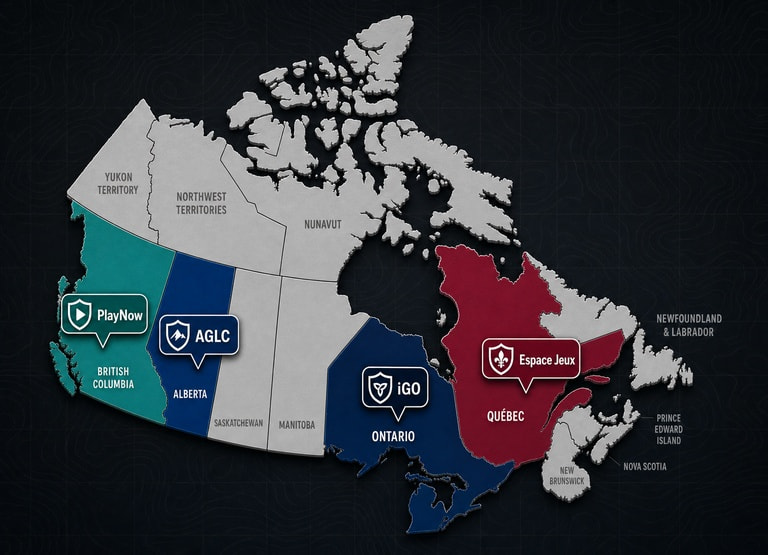
The structural differences between provinces are significant, both on paper and in terms of what players actually experience. Here’s how the three most comparable provinces to Alberta approach it. The territories don’t have a provincial platform, and the Atlantic Provinces are united under one with no private market.
British Columbia (BCLC)
British Columbia runs a government monopoly through the BC Lottery Corporation. PlayNow.com is the only legal online gambling platform available to BC residents; there’s no private operator licensing at all. If you’re a BC player, your regulated options start and end there. The upside is consistency; the downside is that choice is essentially removed from the equation.
Ontario (iGaming Ontario)
Ontario moved furthest from the monopoly model when iGaming Ontario (iGO) launched its open private market in April 2022. Under this framework, private operators including major international brands can register with iGO and offer their services legally to Ontario players.
The result is the most competitive regulated market in Canada, with dozens of licensed operators active. Alberta’s new framework also permits private operators, but Ontario’s market is broader and more open, with more operators having gone through the process.
Québec (Loto-Québec)
Québec’s approach is closer to BC’s. Loto-Québec runs Espace Jeux as the province’s official online platform, and the province has historically taken an assertive stance toward keeping players within that ecosystem. Québec has at various points pushed to block access to offshore sites at the ISP level, a policy that’s facing legal challenges but gives you a clear picture of the province’s general orientation: tightly controlled and government preferred.
Differences Summary for Players
| Province | Regulator | Market Model | Official Platform | Private Operators Licensed | Self-Exclusion Coverage |
|---|---|---|---|---|---|
| Alberta | AGLC | Hybrid (government + private) | PlayAlberta.ca | Yes | All AGLC-licensed sites |
| British Columbia | BCLC | Government monopoly | PlayNow.com | No | PlayNow.com only |
| Ontario | AGCO/iGaming Ontario | Open private market | OLG.ca | Yes (70+ operators) | All iGO-registered sites |
| Québec | Loto-Québec | Near-monopoly (government preferred) | Espace Jeux | No | Espace Jeux only |
Strip away the regulatory structure and you’re left with some practical differences that affect the day-to-day experience of playing. Here’s where the provinces diverge most noticeably:
- Operator choice: Ontario offers the widest selection of licensed private operators. Alberta has a regulated private market, but a smaller pool of licensed options. BC and Québec channel players toward single government platforms.
- Player protections: All four provinces require responsible gambling tools from licensed operators, but the specific requirements differ. Alberta and Ontario both have detailed frameworks with mandatory tools including deposit limits, session controls, and self-exclusion.
- Dispute resolution: Licensed casinos in each province must answer to their respective regulator. Alberta players can escalate unresolved disputes to the AGLC; Ontario players to the AGCO. Government-monopoly provinces handle complaints internally through BCLC or Loto-Québec.
- Self-exclusion scope: All four provinces offer self-exclusion programs, but the breadth of which operators are covered under a single enrolment varies by province. Alberta is promoting the most extensive centralized self-exclusion option available with Ontario offering a strong self-exclusion option.
What Alberta’s Approach Means for You
For Alberta players, the AGLC framework means you’re not navigating an unregulated market when you stick to licensed operators. Those operators have multiple reasons to follow the rules and can lose their license if they don’t comply with player protection standards. That gives you recourse if something goes wrong, which isn’t something you can say about offshore casinos that have no Canadian regulatory accountability whatsoever.
If you’ve noticed that some brands available to Ontario players aren’t licensed in Alberta, the reason is because the licensing landscape here is more selective. The tradeoff is a tighter, more closely supervised market rather than the widest possible selection. For many players, that’s a reasonable trade.
Final Thoughts
Canadian gambling regulation is a genuinely interesting patchwork. It affects which casinos you can use with confidence, what protections you’re entitled to, and where to turn if something doesn’t go as expected.
Alberta’s AGLC framework provides a solid foundation. It’s not the most open market in Canada (that’s Ontario), and it’s not a strict monopoly (that’s BC, Québec). Instead, it sits somewhere practical in between. If you’re choosing where to play, the simplest first step is confirming an operator holds a current AGLC license. The Alberta registrants list is public, takes two minutes to check, and tells you a lot about who you’re dealing with.